
Freelance Videographer Day Rates in the UK (2026)
A videographer's day rate is rarely just a day of filming. It's the camera, the edit, the travel and the quiet weeks, so here's what the published figures say and what each extra line does to the number.
By the Spark team ·
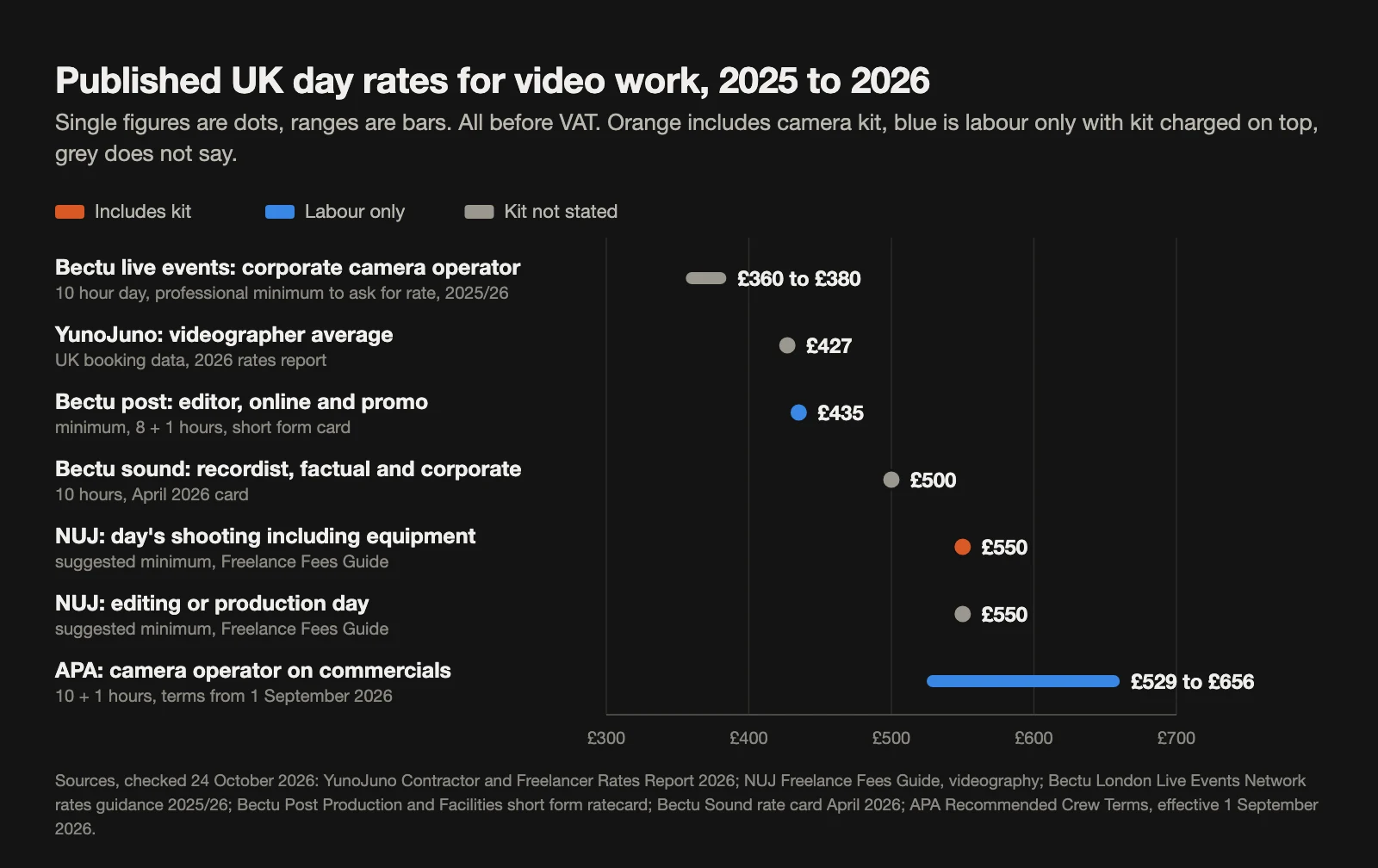
Published UK figures for videographer and corporate camera work put a day at roughly £360 to £550 before VAT, depending on what the day includes. YunoJuno's 2026 rates report gives an average of £427 a day from bookings on its platform. The NUJ's Freelance Fees Guide suggests a minimum of £550 for a day's shooting including equipment, and another £550 for each editing day. Bectu's London live events network puts a corporate camera operator at £360 to £380 for a 10 hour day.
Those numbers aren't arguing with each other. They're pricing different days: one includes a camera package, one is labour only, one is an average of whatever clients happened to book. This guide goes through the lines that move a videographer's quote: kit, half days, edit days, travel, overtime and where you work. If the job needs a dedicated DoP rather than a self-shooter, cinematographer and DoP day rates covers that role.
Spark's founder spent more than ten years running a London production company, hiring and working beside freelance shooters, so this is written for both sides of the invoice. Every market figure links to its source and was checked on 24 October 2026. It isn't financial advice. For your own tax position, ask an accountant.

What the published UK figures say
Here is every public number we could find for this kind of work, with what it covers. Read the kit column before comparing anything.
| Source (date) | What it prices | Figure | Kit |
|---|---|---|---|
| YunoJuno YunoJuno, 2026 report | Average UK day for a videographer, from bookings | £427 | Not stated |
| YunoJuno, 2026 report | Creative roles by seniority, senior to director | £428 to £516 | Not stated |
| NUJ Freelance Fees Guide | Suggested minimum, a day's shooting | £550 | Included |
| NUJ Freelance Fees Guide | Suggested minimum, an editing or production day | £550 | Not stated |
| Bectu Bectu live events, 2025/26 | Corporate camera operator, 10 hours | £360 minimum, £380 to ask for | Not stated |
| Bectu sound card, April 2026 | Sound recordist, factual and corporate, 10 hours | £500 | Not stated |
| Bectu post, short form card | Editor with 3+ years, online and promo, 8 + 1 hours | £435 minimum | £65 a day extra |
| APA crew terms, 1 Sept 2026 | Camera operator on commercials, 10 + 1 hours | £529 to £656 | Labour only |


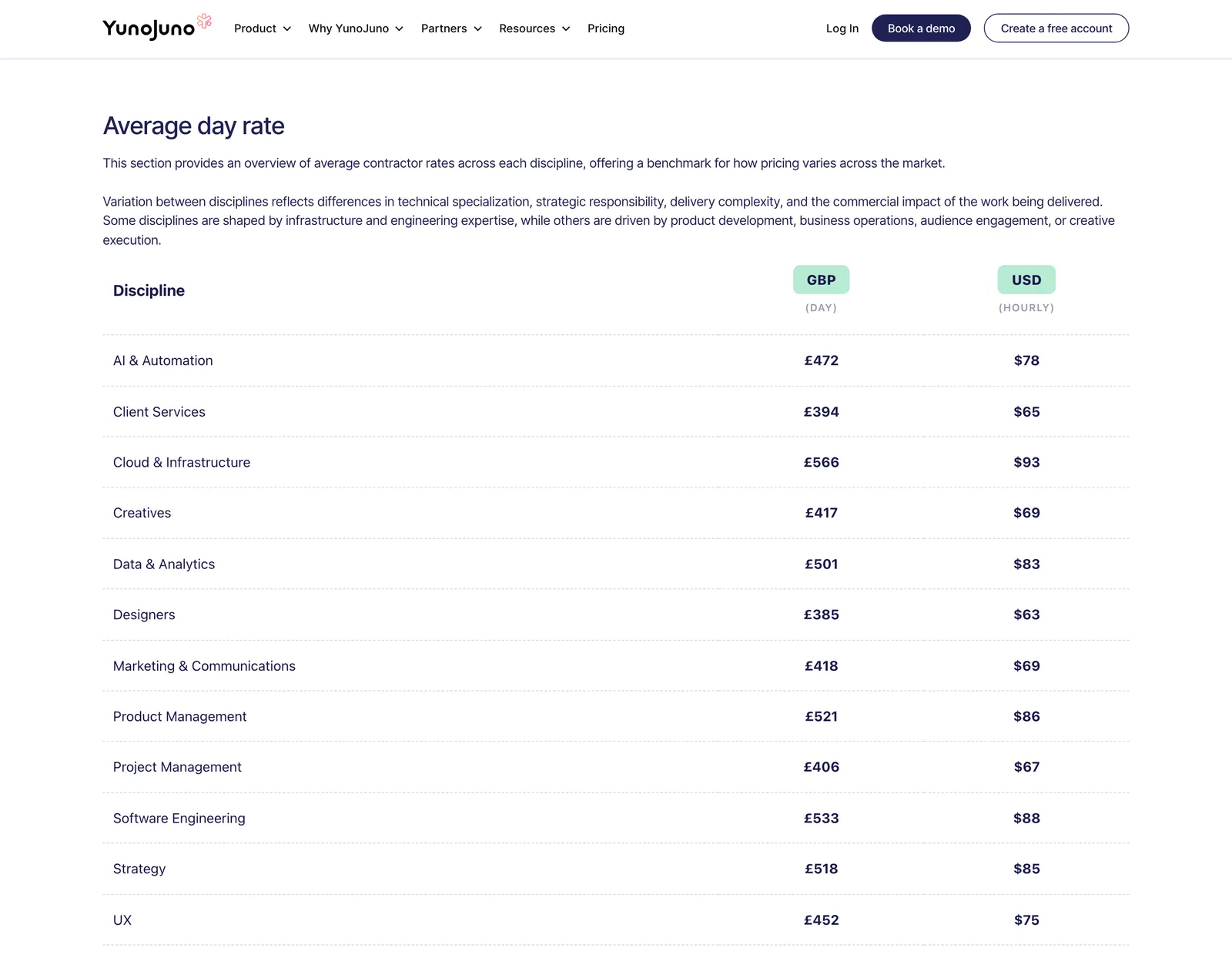
YunoJuno's videographer page is the closest thing to a market average. It's drawn from bookings on YunoJuno, so it reflects the brands and agencies that hire through that platform, and it doesn't say whether kit was included. The same report breaks its creative category down by seniority: £428 a day for senior freelancers, £463 for lead and £516 for director level, with midweight well below the category's £417 average.
The NUJ Freelance Fees Guide is written by the journalists' union for its freelances, and its videography figures are minimums, not averages. Two details in it matter more than the number. It notes that a day's shooting needs at least one, and often two, days of editing afterwards. And it points out that TV freelances usually quote day rates without equipment, while its own £550 includes it.
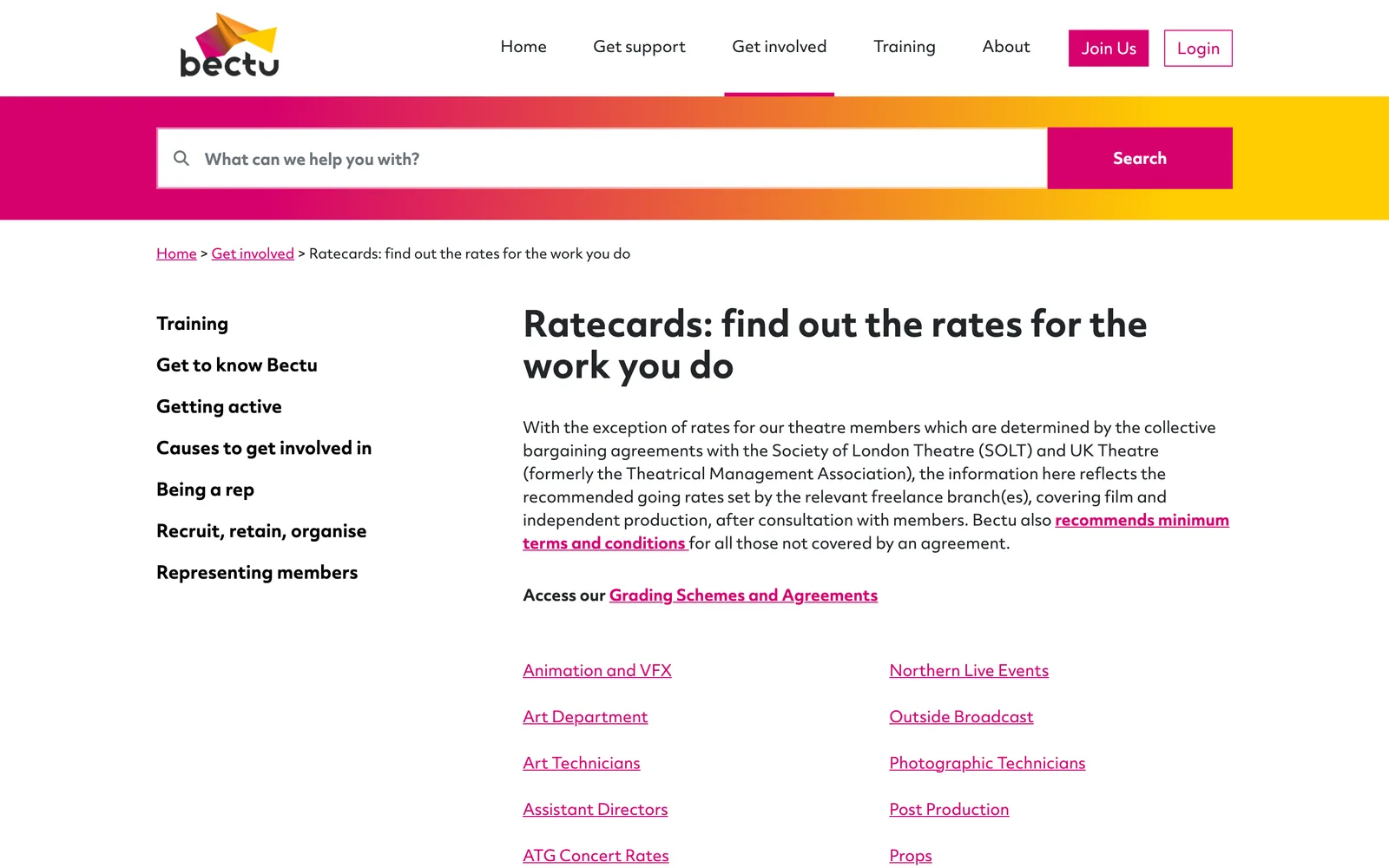
Bectu, the union for UK film, TV and events crew, publishes rate cards by department. There isn't a "videographer" card, because broadcast and film split the job into camera, sound and edit. The closest are the London live events guidance (corporate camera operator), the sound card and the short form post-production card.
Kit is the line that moves the number most
A quote that says "£450 a day" might mean £450 for a person, or £450 for a person, a camera, lenses, lights and microphones. Say which. The Bectu camera branch puts it bluntly on its own rate card: every rate shown is labour only, and crew should keep labour separate from equipment hire, so that a discount comes off the kit and never off the labour rate.
To price your own kit, look at what a rental house charges for it. As of October 2026, Wex Rental lists a Sony FX6 body at £145 a day (plus VAT and a 10% damage waiver unless you have your own insurance), and Floating Harbour in Bristol at £125 a day plus VAT. That's the camera alone, before lenses, media, audio, a tripod or a single light.
What the kit costs you is different from what it's worth to the client. In our illustration below, £3,800 a year of extra kit and insurance adds about £26 a day to a videographer's floor when spread across every billable day. A client hiring the same camera elsewhere would pay more than that before anyone turned it on. So charge kit as its own line, at or a little under hire rates, and keep your labour rate whole.
Half days cost more than half
A half day rarely leaves room for another paid job. The morning shoot finishes at one, you drive home, and the afternoon is gone. That's why our UK freelance day rate calculator prices a half day at 60% of the full day, and why you might decide not to offer half days at all.
None of the union cards we read publishes a half day rate for camera work. The APA's crew terms for commercials don't have one either: a basic working day is 10 hours plus an hour for lunch. If you do offer half days, set a time limit (we'd say four or five hours on site) and say what happens if it runs over.
Editing days are their own line
Shooting days and editing days are different work, and the NUJ guide prices them the same: £550 each as a minimum. Its rule of thumb that one shooting day needs one or two editing days is a useful sense check on any quote that's all shoot and no post.
Bectu's short form post-production card gives a minimum of £435 for an editor with three or more years' experience cutting online and promo content, on an 8 + 1 hour day. It adds £65 a day for basic After Effects work and another £65 a day if the editor supplies the laptop and monitor. For TV commercials the same card's editor minimum is £565.

Write down how many rounds of changes the edit includes. We'd offer two on a short piece, but the number matters less than the fact that it's agreed before the first cut goes out.
Travel, overtime and the length of a day
Day length. Film and TV days in the UK are usually quoted as 10 hours plus lunch, and the APA's commercials terms define the basic working day the same way. Corporate and events work varies, so put your hours on the quote.
Overtime. The Bectu post card pays time and a half after 8 + 1 hours. The APA terms grade overtime by day rate, from 1.5 times the basic hourly rate for lower day rates to 1.0 at the top, and pay triple time after midnight. Pick a rule and write it down; the 11th hour is a bad time to invent one.
Travel time. The APA's terms pay travel time at the basic hourly rate (minus the first hour each way on a working day), and a minimum of five hours for travel on a non-working day.
Mileage. The APA terms pay 50p a mile for locations outside the M25, measured from a postcode in Soho. For your own tax return, HMRC's flat rate for cars rose to 55p a mile for the first 10,000 business miles in the 2026/27 tax year (it was 45p before 6 April 2026). Charge clients for the miles anyway; the HMRC rate is what you can deduct, not what you have to absorb.
London and the rest of the UK
The published data doesn't show a clean London premium. Bectu's sound card says its rates are national and apply across the UK. Malt, which publishes averages for experienced freelancers active on its platform over the last three months, lists UK directors at £434 a day overall: £444 in London, £461 in Birmingham, £409 in Bristol and £371 in Manchester. Most of those city figures come from fewer than ten freelancers, so treat them as a hint, not a map.

What does change in London is cost. Parking, permits, longer travel times between locations and the price of a studio all land on somebody's invoice. Put them on yours as expenses, not inside the day rate, so the rate stays comparable when you work elsewhere.
Work out your own floor first
Market figures tell you what clients pay. They don't tell you what you need. The method is in our guide to calculating a freelance day rate: the take-home you want, plus tax, plus costs, plus a buffer, divided by the days you'll really bill.
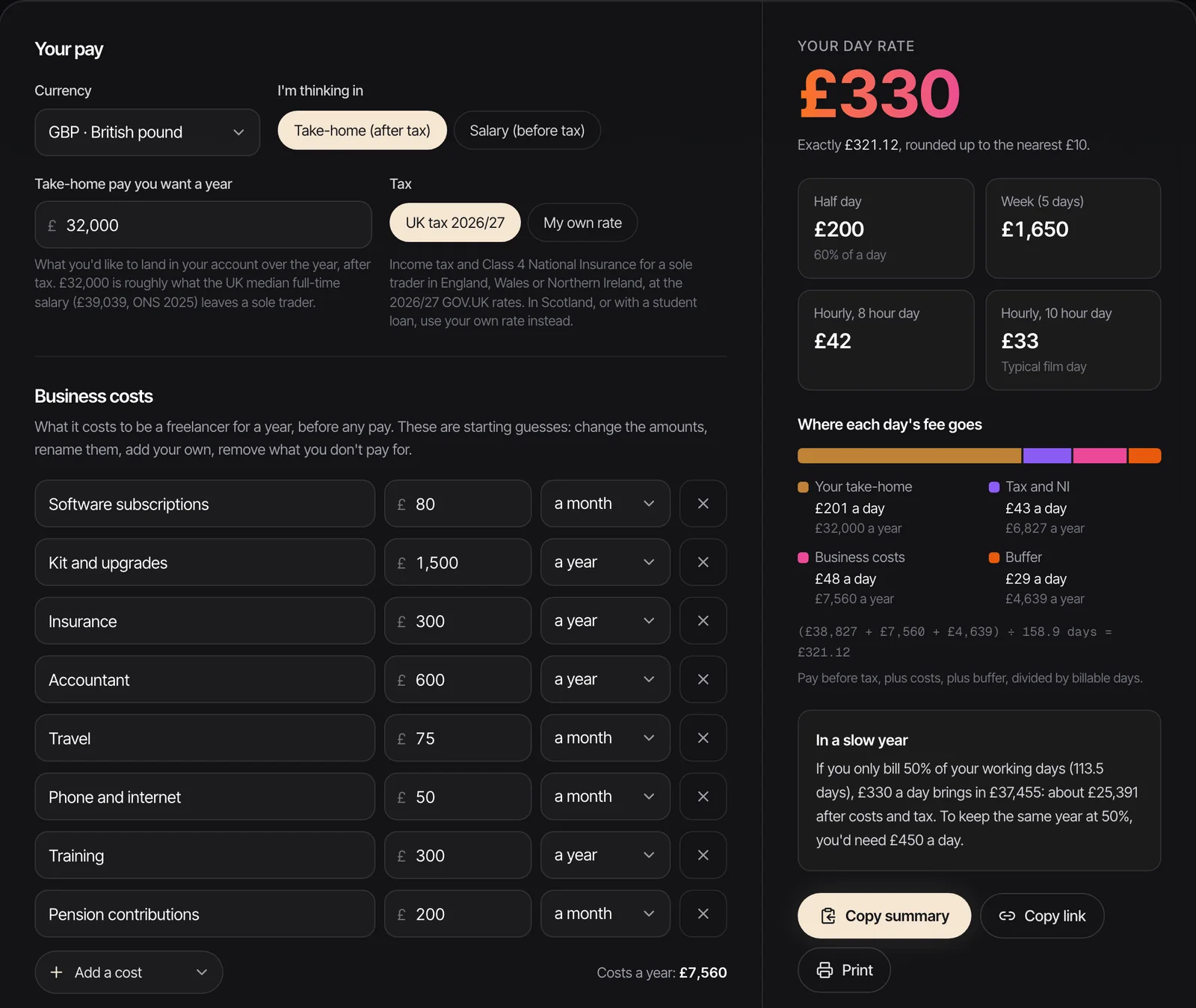
Here's an illustration for a videographer who owns a camera package, using the calculator's own engine:
| Input | Calculator default | Videographer with kit |
|---|---|---|
| Take-home wanted (2026/27 UK tax) | £32,000 | £32,000 |
| Kit and upgrades a year | £1,500 | £5,000 |
| Insurance a year | £300 | £600 |
| All business costs a year | £7,560 | £11,360 |
| Buffer | 10% | 10% |
| Billable days (70% of 227) | 158.9 | 158.9 |
| Day rate (rounded up) | £330 | £350 |
| Half day (60%) | £200 | £210 |
Then watch the billable share. Same kit, same take-home, fewer paid days:
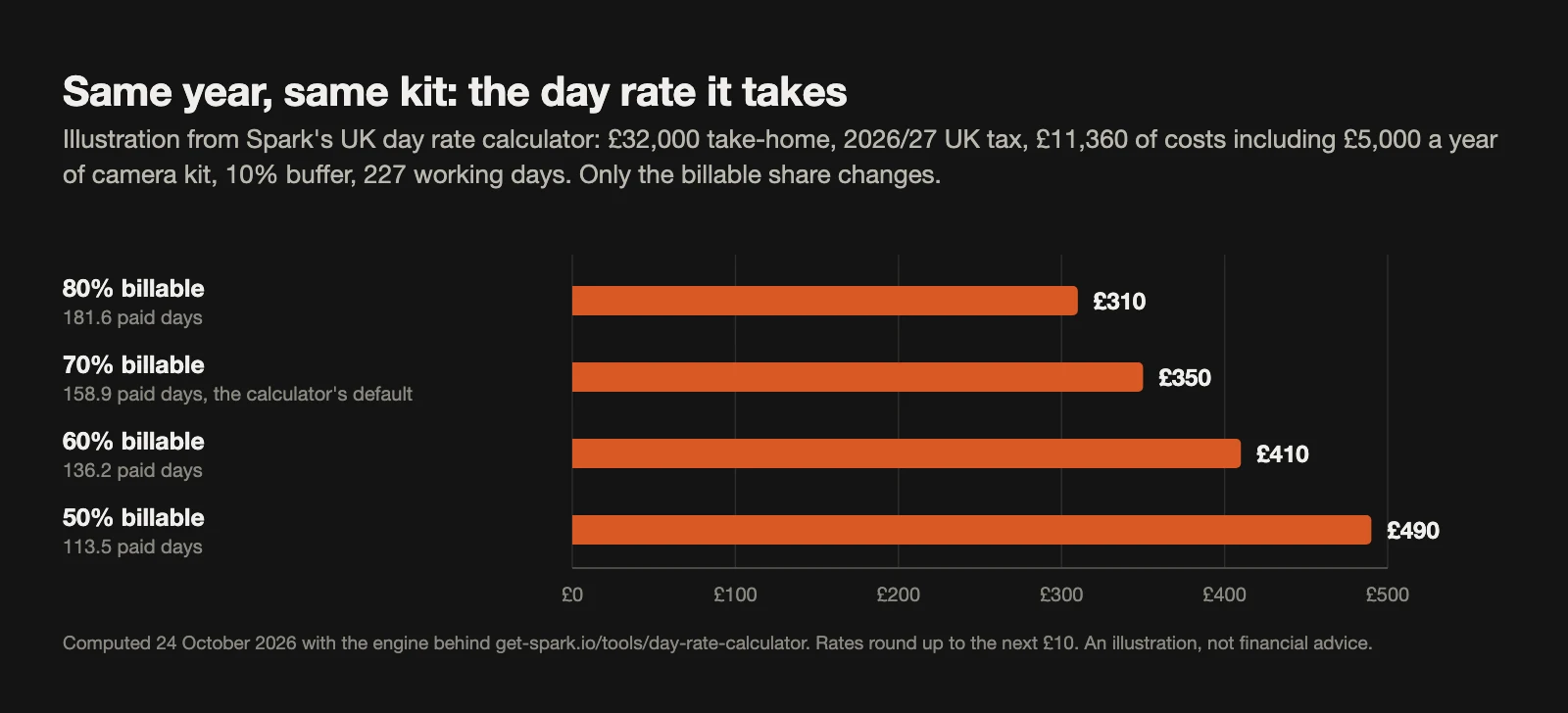
That's the case for charging kit separately. The kit adds about £26 a day to the floor. A quiet diary adds £140. If you're new and your days are patchy, plan for 50 to 60% and price for it.
Want to know what a rate is worth as a salary? Our day rate to salary guide runs the same maths backwards, with a table of example rates.
What buyers should expect on a videographer's quote
If you're booking a videographer rather than being one, a good quote is easy to recognise. It says:
- How long a day is, and what overtime costs after that.
- What kit is included, as a list, and what's charged separately.
- How many shooting days and how many editing days, and how many rounds of changes.
- Travel time, mileage and any parking or permit costs.
- What you can do with the film (where it's shown and for how long), because the NUJ guide notes that copyright in freelance video belongs to the videographer under UK law, and its rates assume a limited licence.
- What happens if you cancel. The APA's commercials terms charge nothing with seven or more days' notice, 50% at four to six days, 75% at two to three, and the full fee the day before.
- Whether VAT is added. Freelancers must register for VAT once their taxable turnover passes £90,000 in a rolling 12 months.
A quote that's one number with none of this isn't cheaper. It's just harder to compare. For the wider picture, including crew, locations and post, see how much video production costs in the UK.
The quickest way to get an accurate quote is to send references. A handful of clips that show the look, the pace and the setups will tell a videographer more about the kit and the days than a page of adjectives. Our guide to turning references into a shot list shows how to do it, and these commercial film inspiration sites are a good place to find them. On bigger jobs the references usually live inside a treatment.

Spark won't set your rate. It will help you turn up already knowing what the client means by "cinematic".
FAQs
How much does a videographer cost per day in the UK?
Published figures for 2025 and 2026 range from about £360 to £550 a day before VAT. YunoJuno's average from its own bookings is £427, and the NUJ suggests a minimum of £550 for a day's shooting including equipment. The real price depends on kit, editing days, travel and experience, so ask for a quote that lists each one.
Does a videographer's day rate include equipment?
Sometimes, so always ask. The NUJ's suggested £550 includes equipment, while broadcast crew and Bectu rate cards quote labour only and charge kit separately. As a guide, two UK rental houses list a Sony FX6 body alone at £125 and £145 a day plus VAT.
What is a videographer's half day rate?
There's no published standard. Many freelancers charge around 60% of a full day, because a half day rarely leaves room for another paid job, and our free day rate calculator uses 60%. Agree the hours and the overtime rate in advance.
How many editing days does a one day shoot need?
The NUJ's Freelance Fees Guide says a day's shooting needs at least one, and often two, days of editing afterwards. Simple social cutdowns can take less and graded, mixed films more, so ask for edit days to be listed separately from shooting days.
Do videographers charge more in London?
The public data doesn't show a clear London premium. Bectu's sound card applies one national rate, and Malt's city averages for directors put London below Birmingham, from small samples. London jobs do carry higher costs, such as parking, permits and studio hire, which belong on the quote as expenses.
How do I work out my own videographer day rate?
Add the take-home pay you want, the tax on it, your yearly costs (kit and insurance included) and a buffer, then divide by the days you'll really bill. Spark's free UK day rate calculator does this with 2026/27 tax built in. Then compare the result with the market figures above.
Keep reading
All articles
How to Build a Video Ad Swipe File That Your Team Actually Uses
Saving an ad takes ten seconds. The swipe files that get used are the ones where someone can find the right opening months later, without remembering who made it.

How to Use ChatGPT and Claude for Creative Research (and With Your Reference Library)
An AI chat is a brilliant vocabulary partner and an unreliable librarian. Use it for the first job and it saves hours. Trust it with the second and you'll be hunting for films that were never made.
How to Make a Ripomatic (or Mood Film) for a Pitch
A good ripomatic lets a room feel the film before it exists. A careless one turns up online with other people's footage and your client's logo on it.