
Director's Treatment Examples: What Winning Commercial Treatments Include
Real commercial treatments rarely go public, because they carry someone else's script. So here's where to find the ones that are, and an invented one built page by page to show what each page is for.
By the Spark team ·

A winning commercial treatment usually runs in this order: a cover, a short personal letter, the idea in one line, the film beat by beat, look pages, casting and performance, camera, locations and design, edit and sound, and a last frame. Each page proves one thing, and the best ones prove it with a picture and a sentence. Real examples are hard to find because commercial treatments carry an agency's script and an unreleased campaign. The public ones are mostly treatment designers' portfolios and music video treatments, and they're listed below.
Then we build one. Real pitch treatments are confidential, so we invented a brief and made the pages from film stills in our kit. For how to write the words, read our guide to building a film treatment. This post is about what the finished pages look like and what each one is there to do.
Where to see real director's treatment examples
These are public, posted by the people who made them, and worth an evening.
| Where | What you'll see | Bear in mind |
|---|---|---|
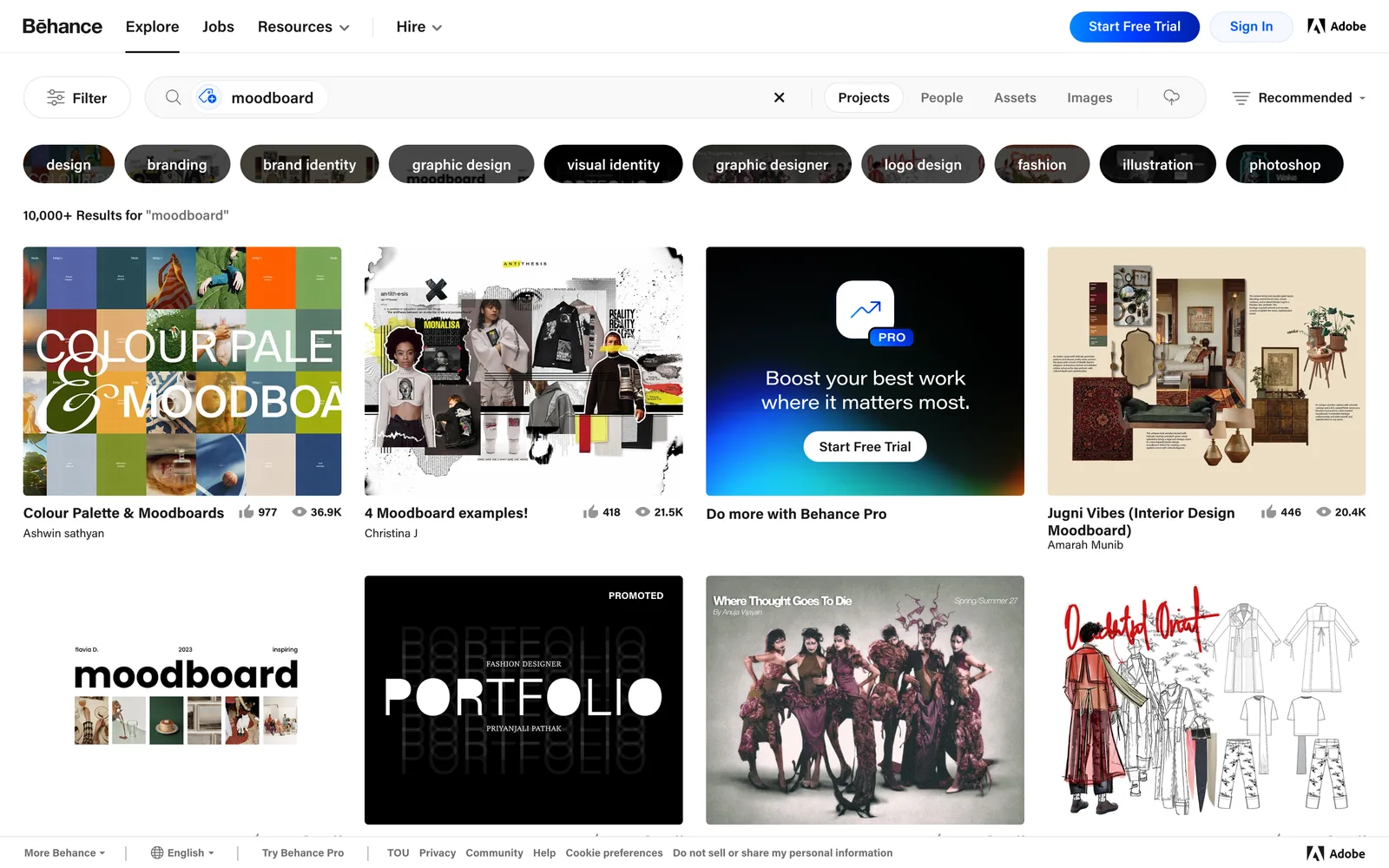
| Behance Behance | More than 10,000 results for director's treatment, mostly posted by treatment design studios, page by page | Portfolio pieces: the polished final version, shared with permission |
| The Collective Pitch's Nike treatment | A treatment for Nike's Says Who spot with Ja Morant, which the studio describes as a winning bid | Designed by a treatment studio for a director, so the layout is theirs |
| The Betterment Society | Sample treatments by genre, plus short excerpts of the writing from intros and tone pages | A writing and design studio's samples, chosen to sell its services |
| No Film School | Daniels' original treatment for Turn Down for What, as a PDF | A music video, and proof that a winning idea can sound silly on paper |
| Reddit WDMV Treatment Database | Music video treatments shared by directors through We Direct Music Videos, for education | Mixed quality and budgets; read a lot, copy none |


Three things stand out across them. Section divider pages do the navigation: the Nike treatment breaks into chapters with big type pages such as Look and Memphis, and Camera and Scenes. The writing is personal and specific, in the first person, about a place or a feeling the director knows. And the pictures carry most of the weight. Look at them for structure and pace. Don't lift a layout wholesale, because the agency may have seen it last month.
A commercial treatment, page by page
To show the pages without reproducing anyone else's, here's one for a brief that doesn't exist: a 60 second film for a fragrance called Salt. One woman walks out of the desert and keeps going until she reaches the sea. Every frame is a credited film still, used the way a treatment uses references: for one quality each.
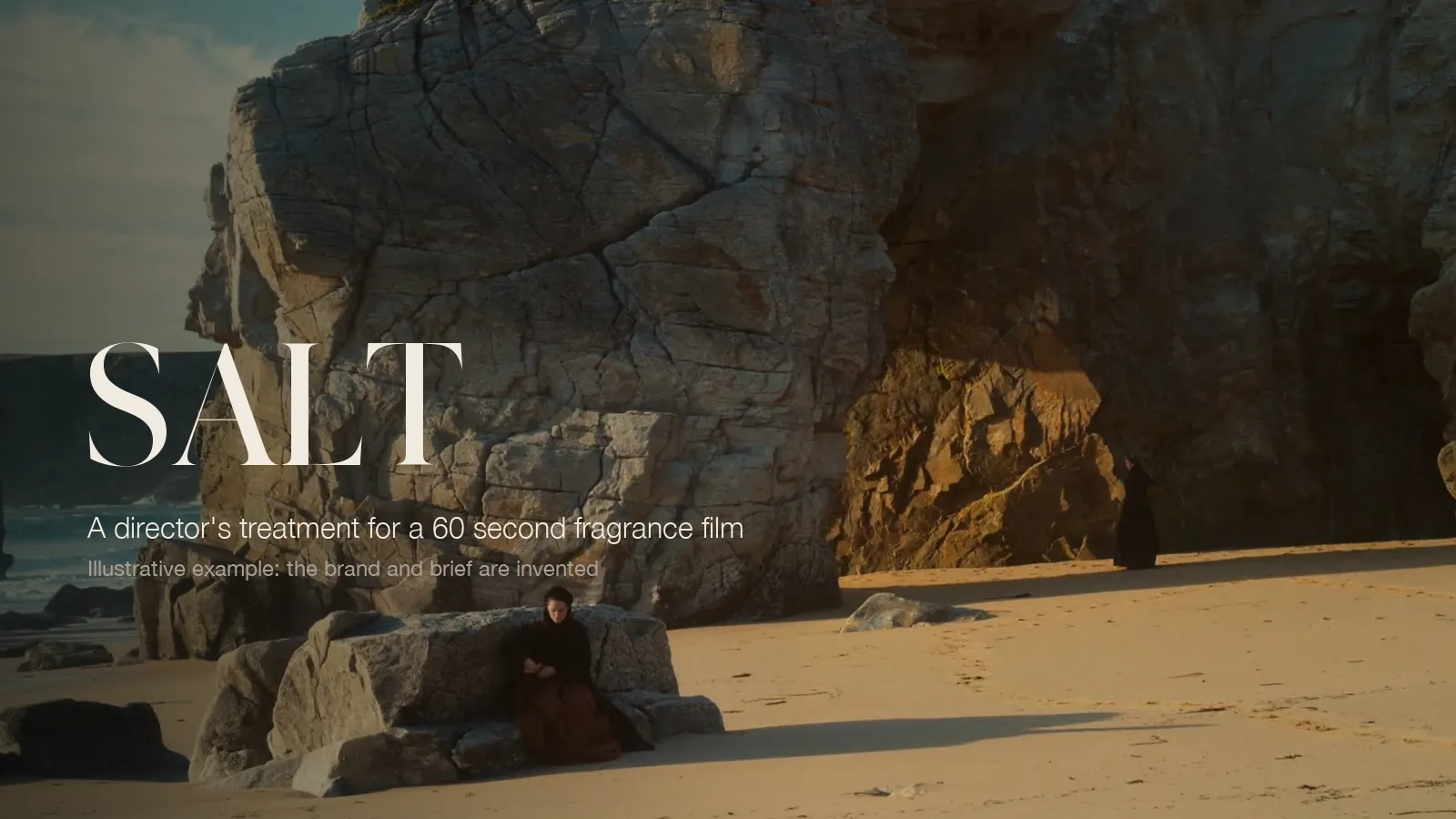
Page 1: the cover
One picture, the title, the client, your name. The cover proves taste in about a second, which is all it gets in a pitch email. A frame from the film's own world works better than a pretty generic one, and type that's readable at thumbnail size matters, because that's how it first appears.
What sinks it: a collage. Four images on a cover say you couldn't decide.
Page 2: the letter
Half a page, written to the creatives. What you love about their script, what you think it's really about, and the one decision you'd make that the others won't. The Betterment Society's excerpts are a good read here: they open with a place or a memory, then turn it into a reason for the film.
What sinks it: a CV. The agency already chose to send you the brief; this page is about their film, not your awards.
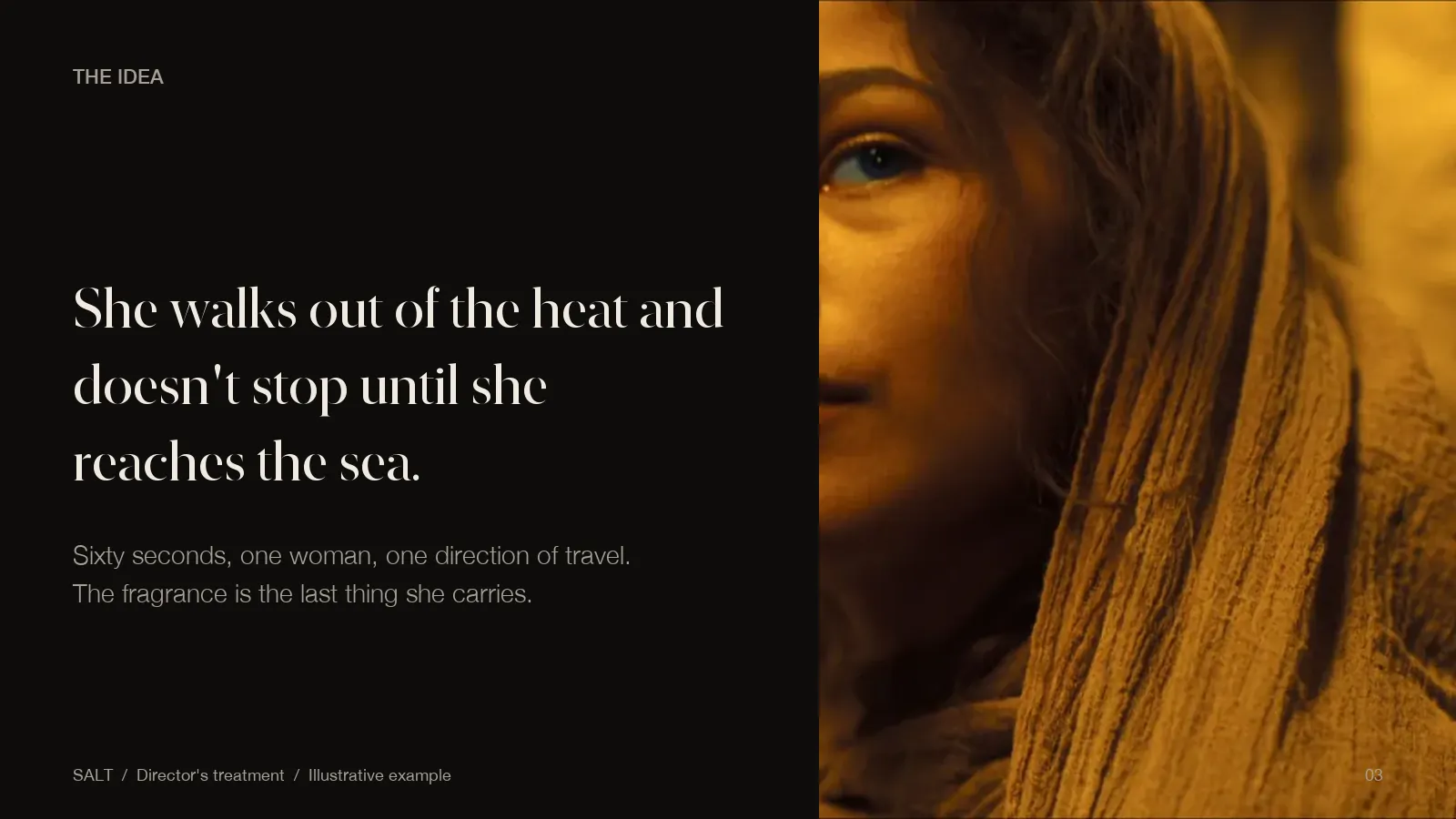
Page 3: the idea in one line
If the client only reads this page, they still get it. One sentence, in the present tense, that a marketing director could repeat to their boss.
What sinks it: an idea that quietly replaces the agency's. Interpreting the script wins pitches. Rewriting it rarely does.
Page 4: the film, beat by beat
The whole film told in the present tense, usually as a run of frames with a line under each, like a contact sheet. "We open on her back. Heat haze. She doesn't turn round." This is where the client checks the product turns up, and when.
What sinks it: beats that read like a shot list. Save "MCU, slow push" for the shot list. Here, say what the audience sees and feels.
Page 5: the look
Three or four frames, a line under each saying what it's there for, and often a palette. This is the page clients remember, and the one most likely to be misread, so every frame names its one quality.
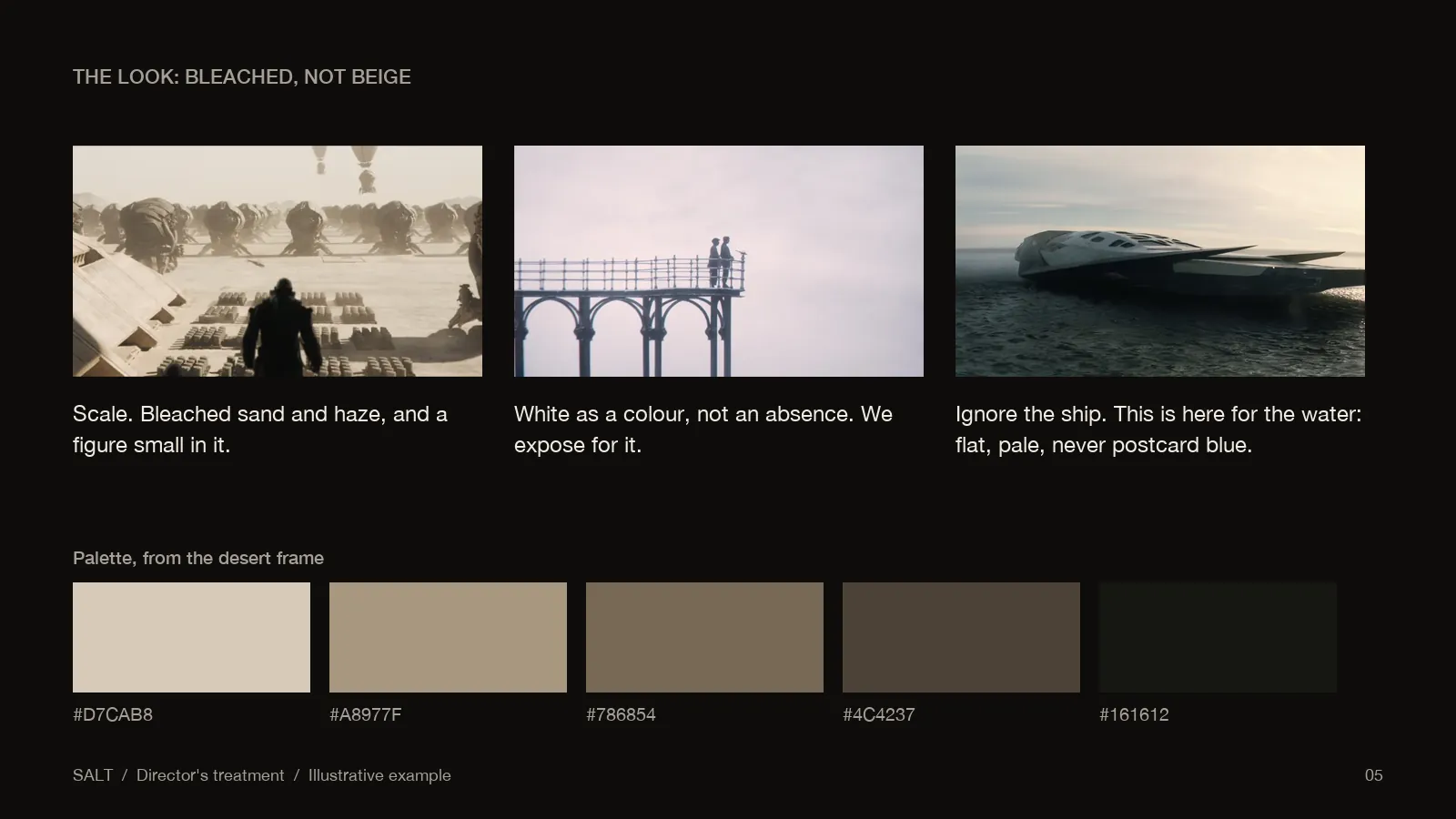
The palette swatches are the desert frame's own colours, pulled with the free colour palette extractor, so the grade conversation starts from numbers. Our guide to making a moodboard for a video project goes deeper on choosing these frames.
What sinks it: twelve beautiful landscapes with no captions. That's a mood, not a decision.
Page 6: casting and performance
Who these people are and how they behave on camera. For Salt it's one woman who looks like she's walked a long way. Not a model pose in sight. On dialogue and comedy scripts this section grows into several pages, because performance is the film.

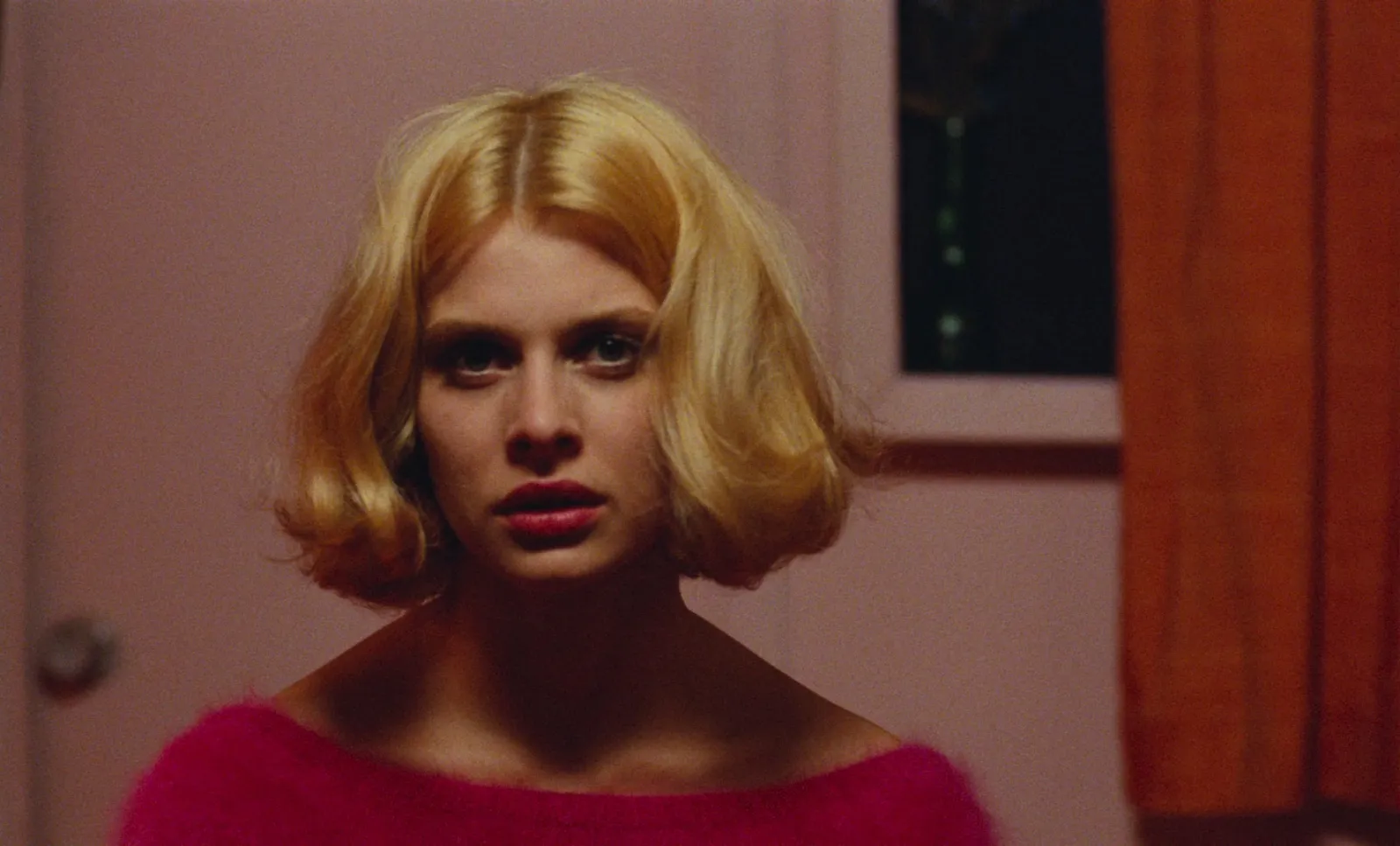
What sinks it: headshots of famous actors the budget can't afford, with no note saying they're for type only.
Page 7: camera
How the camera behaves and why. Two or three rules beat a lens list. This is also where a treatment sent as Keynote or PowerPoint can move: a looping reference on the page shows the behaviour in a way no sentence can.
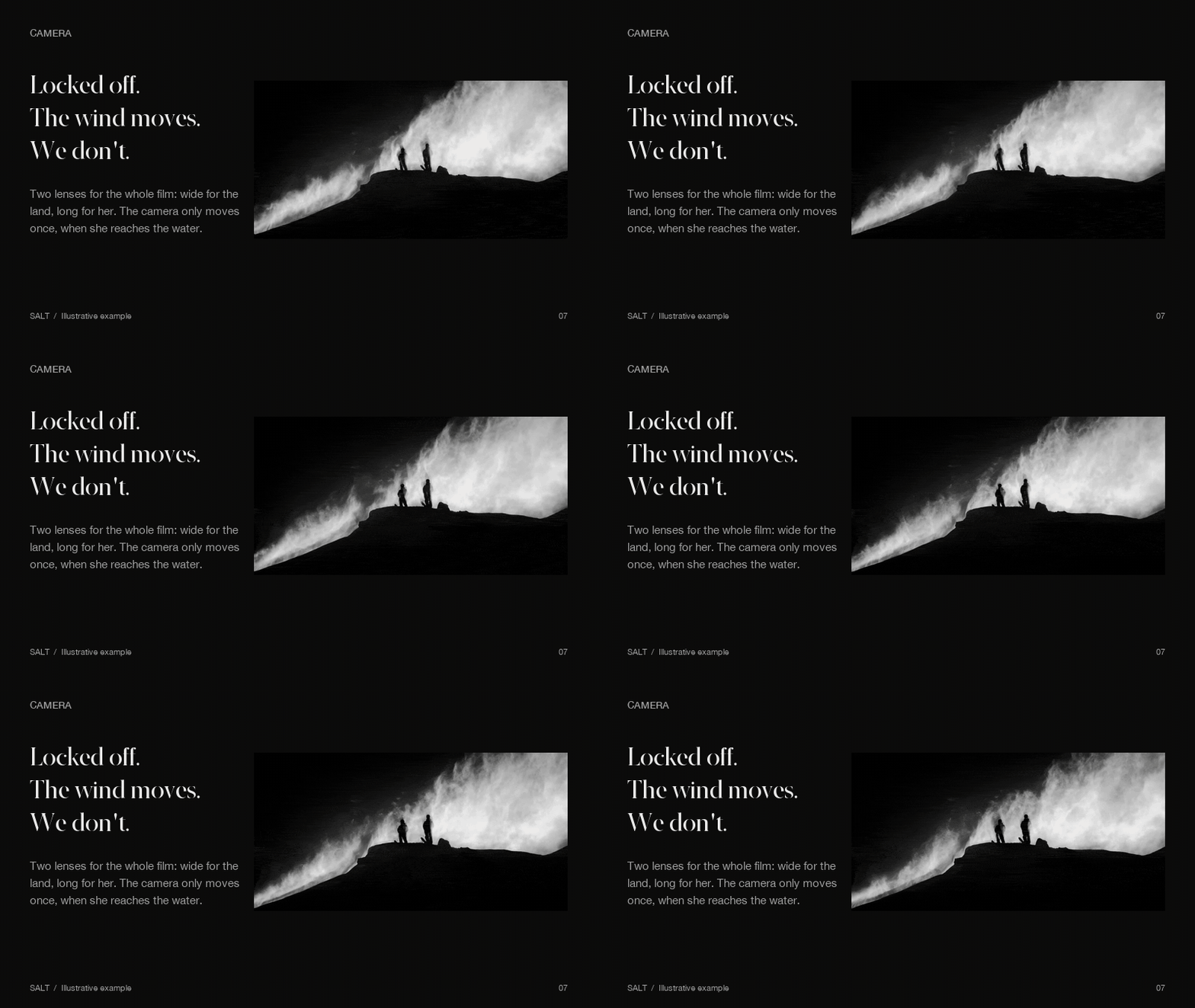
What sinks it: a kit list. The DoP will choose lenses; the agency wants to know what the camera feels like.
Pages 8 and 9: locations, design, wardrobe and sound
Where it happens and what the world is made of, then how it sounds and cuts. For Salt that's one location type (salt flats, then a pale beach), a two colour wardrobe, and a sound idea: wind and footsteps all the way through, and the sea arriving before we see it. If the film hangs on a transition, give it a page; our guide to match cuts shows what has to line up.
A production approach page often follows, and producers love it: how many shoot days, what's in camera and what's post, how weather is covered. It tells the agency the idea fits the money before anyone asks.
Page 10: the last frame
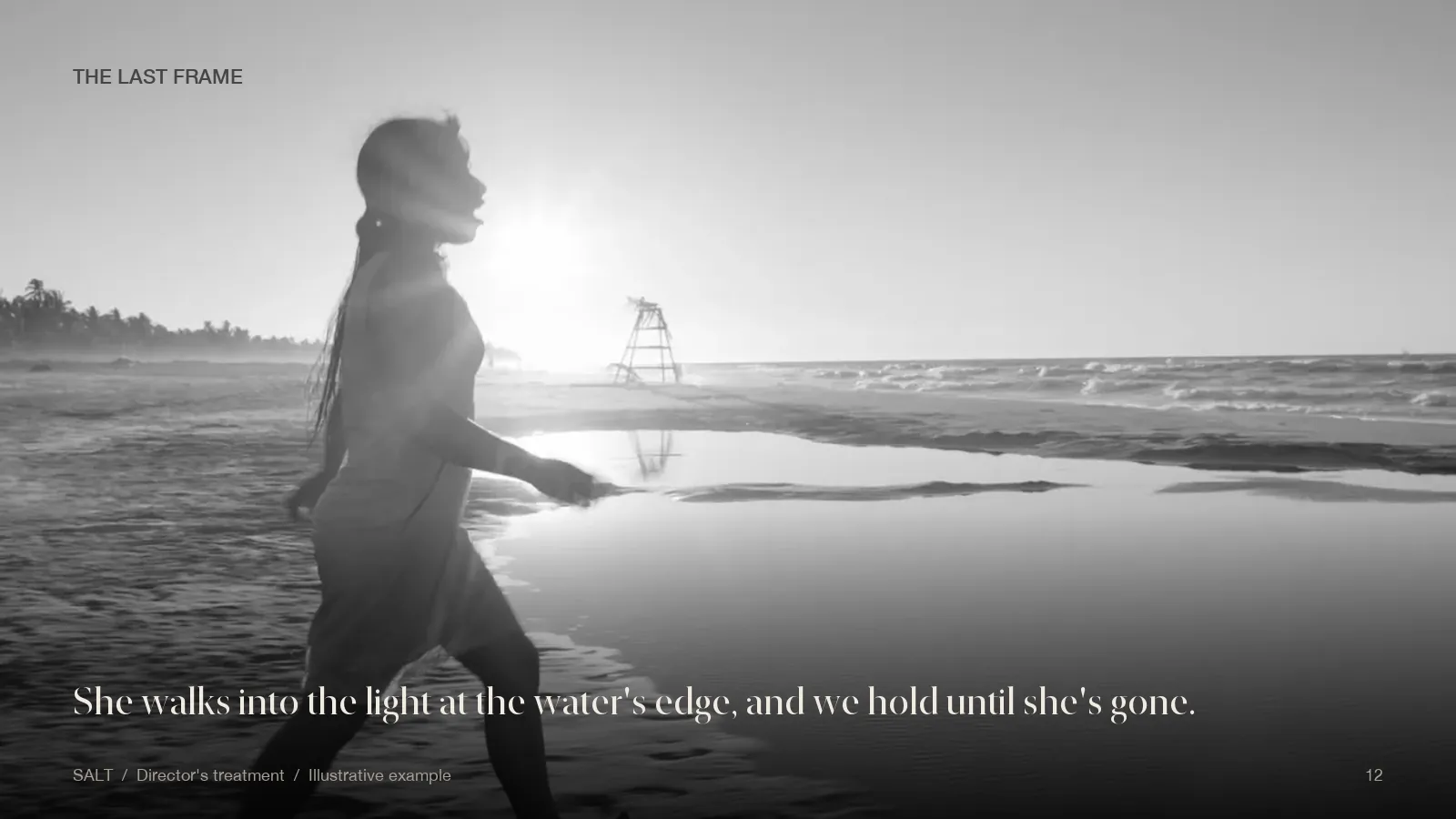
End on the image you'd end the film on, and stop. No thank you page with a phone number.
How the pages change by type of job
The order above is the skeleton. Which pages grow depends on the script.
| Type of job | Pages that grow | Pages that shrink |
|---|---|---|
| Dialogue or comedy | Casting, performance, timing references | Look, camera |
| Visual brand film | Look, camera, sound | Story beats can fit on one page |
| Sports or talent | How you'll get the shots in the talent's limited time, access, safety | Casting |
| Product or tabletop | Product hero frames, lighting, rigs, macro and speed | Story, casting |
| Real people or documentary style | Approach, casting process, how you'll treat contributors | Look |
| Social first, many cutdowns | A deliverables map: which shots make the 6, 15 and 30 second and 9:16 versions | Long story pages |
That last row is becoming its own page in a lot of treatments, and it's worth stealing. If the brief asks for vertical cutdowns, show which moments survive the crop. A video creative brief that lists every deliverable makes this page easy to write.

What the winning ones have in common
From the public examples, the treatments that get remembered share five habits.
- They're navigable. Section dividers, page numbers, one idea per page. A reader can jump to Casting in two taps on a phone.
- Every reference has a job. A line under each frame, saying what to take from it.
- The product appears early. By page four the client has seen where the brand lives in the film.
- They look like the budget. References that cost roughly what the client is spending reassure. A sense of where commercial film inspiration comes from helps you pick them.
- They hand over cleanly. If you win, the look pages become the visual style guide and the beats become the shot list, so keep the source of every frame.
Music video treatments follow a different set of rules (artist, commissioner, budget), and we've broken those down in our music video treatment template.
Building the pages from your own library
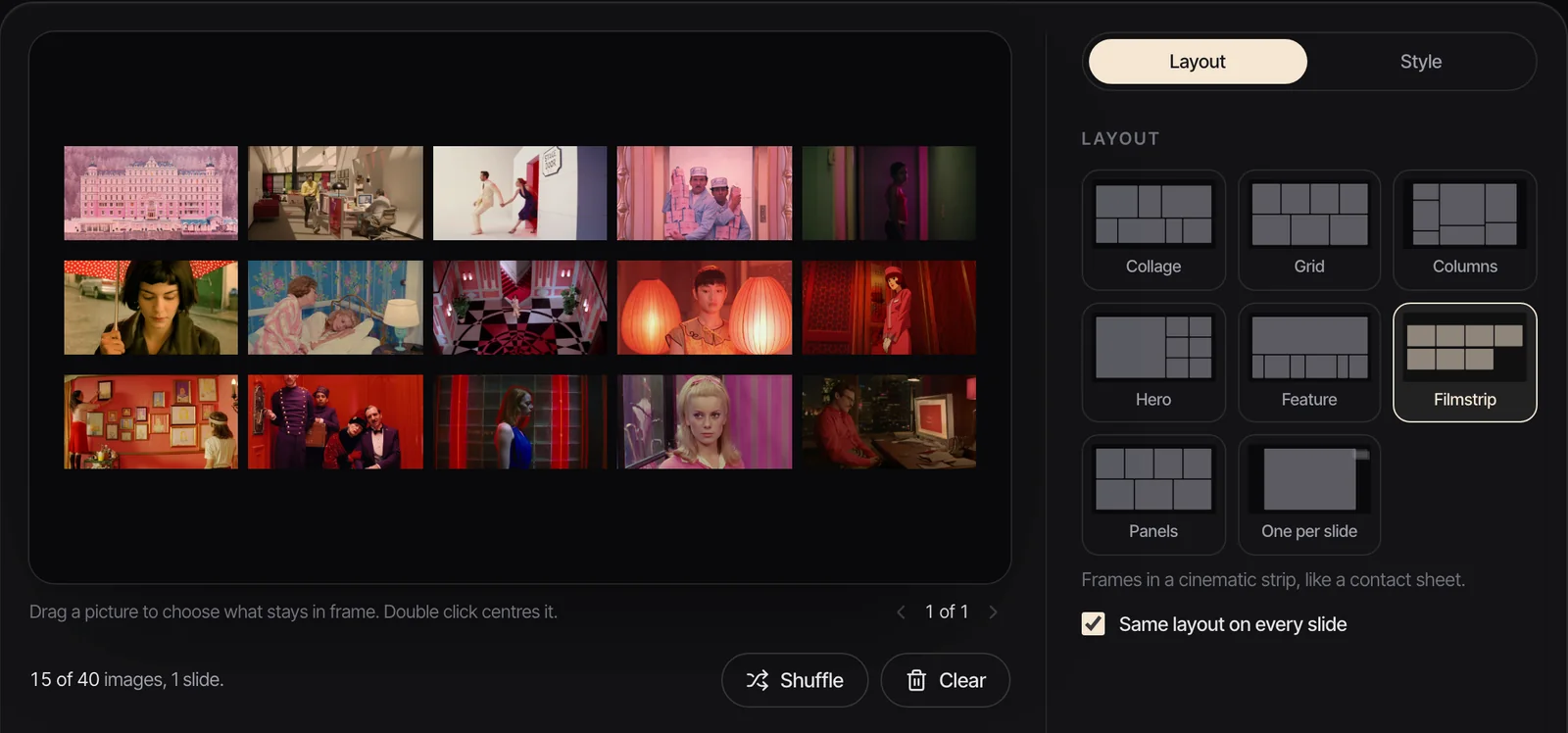
The slow part of any treatment is finding the frame you half remember. Keep a pitch's references in one Spark collection, pull frames and GIFs from the exact moments you mean, and lay them out with Create Moodboard, which exports to Keynote, PowerPoint, Google Slides, Canva or PDF. GIFs keep moving in everything but the PDF.
No Spark? Our free moodboard maker lays out stills and GIFs in eight layouts and exports a .pptx with the GIFs still playing.
FAQs
Where can I find director's treatment examples?
Behance has thousands, mostly posted by treatment design studios with permission. The Collective Pitch and The Betterment Society publish samples on their own sites, No Film School hosts Daniels' Turn Down for What treatment, and the WDMV Treatment Database on Reddit collects music video treatments for education. Real commercial treatments are rarely public because they contain the agency's script.
How many pages should a commercial treatment be?
The ones that work tend to run 10 to 20 horizontal pages, mostly pictures, while No Film School puts it at 5 to 12. The deadline and the size of the job decide. What matters more is that the cover, letter and idea page carry the pitch on their own.
What pages does a director's treatment include?
A cover, a personal letter, the idea in a line, the film beat by beat, look, casting and performance, camera, locations and design, wardrobe, edit and sound, and a last frame. Many add a production approach page and a deliverables map for cutdowns. The script decides which of these grow.
Does a commercial treatment include the budget?
Usually not. The treatment is the director's creative pitch, and the production company's producer sends the cost separately. A production approach page can still show the idea fits the money, for example by saying what's done in camera and what's done in post.
What's the difference between a treatment and a pitch deck?
In commercials the words are used loosely and often mean the same document. When they differ, a treatment is the director's response to someone else's script, while a pitch deck sells your own project, such as a feature or series, to funders. The structure and the reader are different.
Can I copy a treatment template?
Use a template for structure, not for look. Agencies see a lot of treatments, and a layout they recognise from someone else's pitch works against you. Build the pages around your own frames and words.
Keep reading
All articles
How Much Does Video Production Cost in the UK? (2026 Guide)
Every video quote is the same handful of lines in different sizes. Here they are, priced from published 2026 rates, with three worked budgets and the questions that get you a quote you can compare.
How to Collect References From Clients (Without 40 WhatsApps)
A client who sends forty links has told you everything and nothing. Ask for four, each with a sentence and a timecode, and you'll learn more.
Video Production Proposal Template (and What Clients Actually Read)
Clients read three things in a proposal: whether you understood them, what they'll get, and what it costs. Here's a template built around those, with every budget line explained.